Montblanc
A strategy nobody asked for, on a luxury house whose flagship product is a fountain pen in a world that has stopped writing.

The challenge
Nobody set this one either. Montblanc has sold writing instruments since 1906, and the Meisterstück has been its centre of gravity for a century. Handwriting, meanwhile, has been in structural decline for a generation. I wanted to know what a house sells when the activity its flagship product exists for is quietly disappearing.
Method
The insight
The obvious answer is diversification, and the house has already taken it: watches, leather goods, fragrance, accessories. Reduce the dependency on a shrinking category.
That is a hedge rather than a strategy. It trades a house with a singular meaning for another luxury accessories brand, competing with houses that are structurally better at accessories, and it treats the pen as a legacy problem to be managed down.
Look instead at how these objects are actually acquired. Almost nobody buys a Meisterstück because they need a better pen. It is given: at a graduation, a first job, a promotion, a retirement, a father to a son. The purchase occasion is a threshold, and the object's job is to make that threshold permanent.
Which changes the size of the problem entirely. The decline of handwriting threatens the pen's function. It does not touch the reason anyone acquires one.
Montblanc isn't in the writing business. It's in the business of making a moment permanent, and that market isn't shrinking.
The idea
Stop defending writing and start owning thresholds. Map the moments a life turns on and a twenty-five year hole opens in the middle of it, between a milestone birthday and retirement. Things happen in those years. People become parents, start companies, buy houses, take citizenship. Nobody sells a gift for any of it.
What every one of those moments has in common is that something gets signed. A birth register, articles of incorporation, a deed, an oath. So the idea is simply this: Montblanc shows up when something is signed.
It ships as a concierge first, a pen delivered to a named venue on a named date in a milestone box with an engraving slip inside, booked through property brokers and private banks. That carries the volume. Boutique signing appointments carry the story. And where signing has gone digital, the friction is the product: clicking agree on a screen costs nothing, taking a pen out of a box to sign a deed has weight.
The test isn't whether people still write. It's whether, when something in a life is worth marking, Montblanc is the first place anyone thinks of.
The deck
-
Cover. The argument written up as it would be presented. Sourced against Richemont’s published results and third-party market sizing, with the occasion analysis run through Cero, and ending on what would stop it.
-
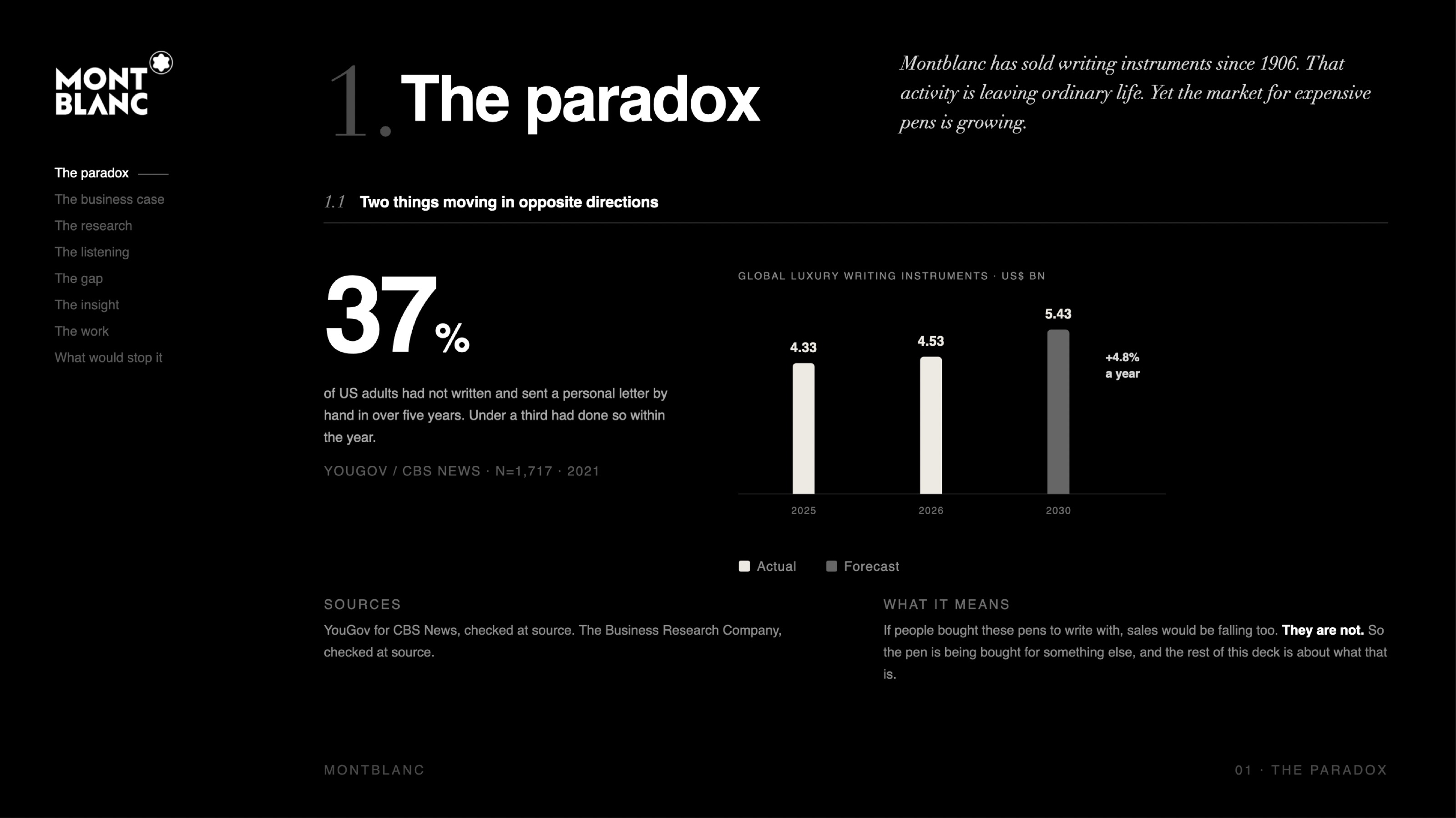
The paradox Handwriting collapses, the pen market grows to $4.53bn anyway.
-
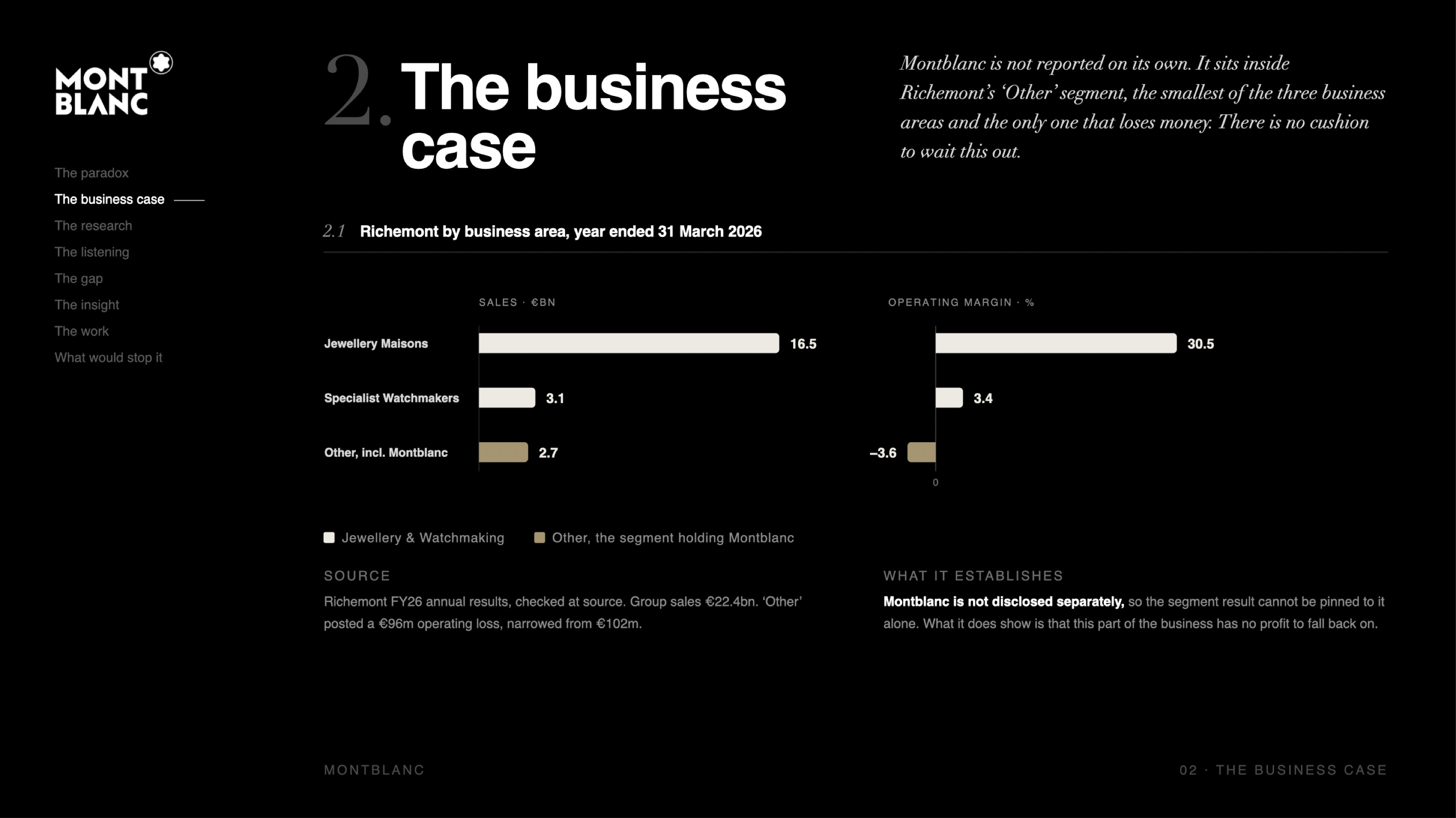
The business case Richemont FY26. €2.7bn of sales at a €96m loss against Jewellery’s 30.5%.
-
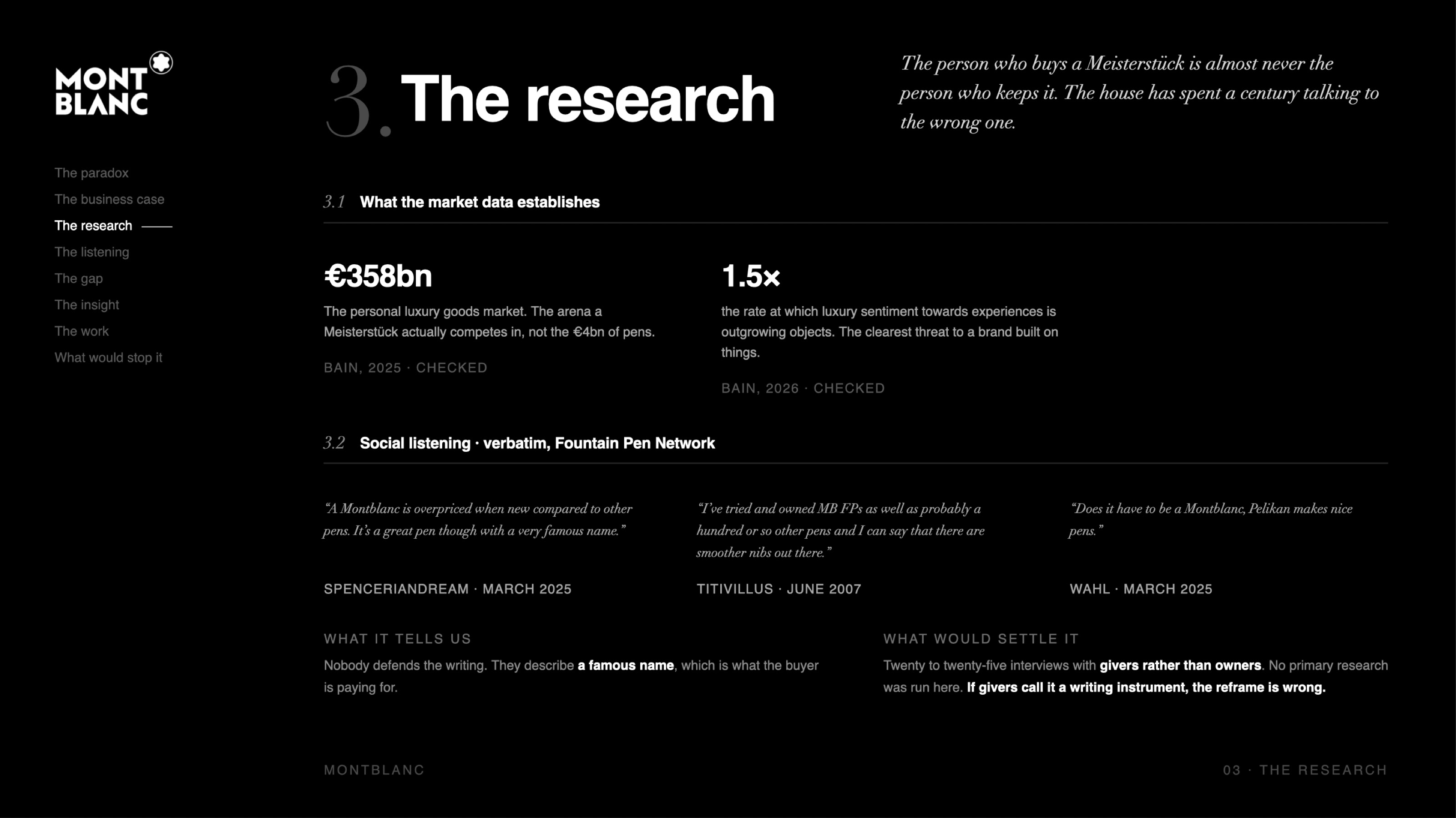
The research Market data checked at source, and social listening quoted verbatim.
-
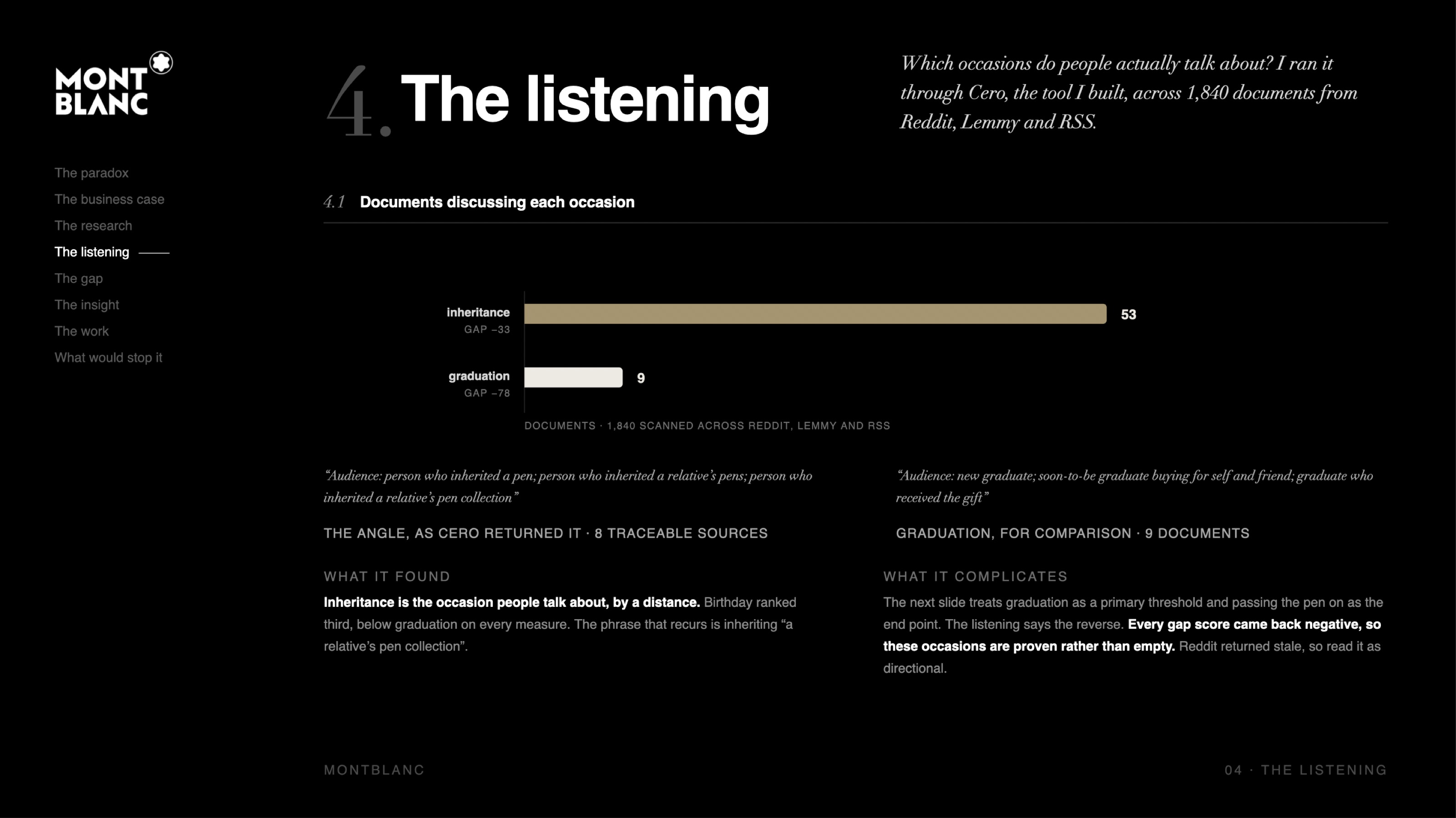
The listening Occasion analysis run through Cero, the tool in case 01, across 1,840 documents. Inheritance leads by a distance, which complicates the slide that follows it.
-
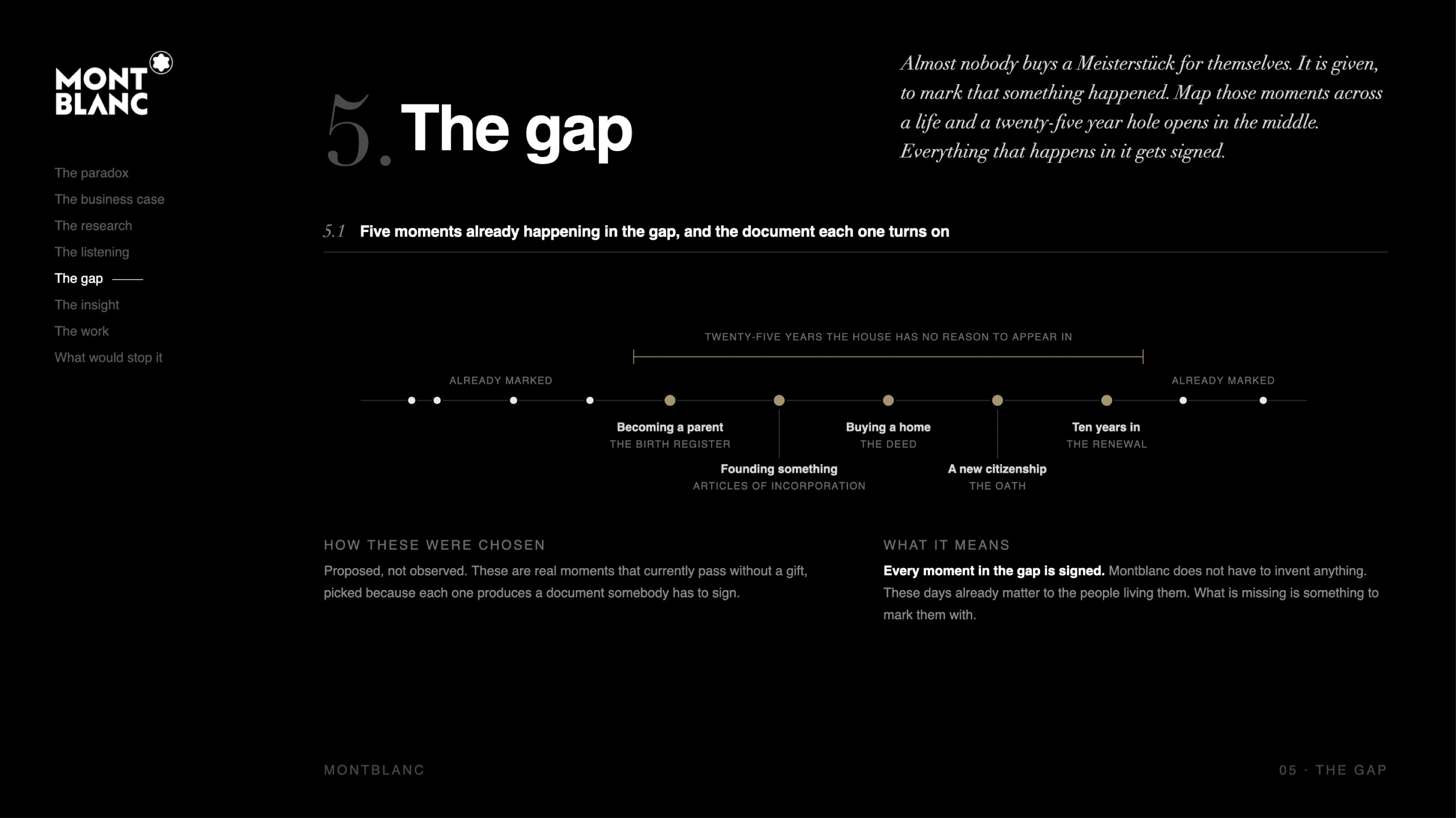
The gap Five moments a life turns on that pass without a gift, each paired with the document signed at it.
-
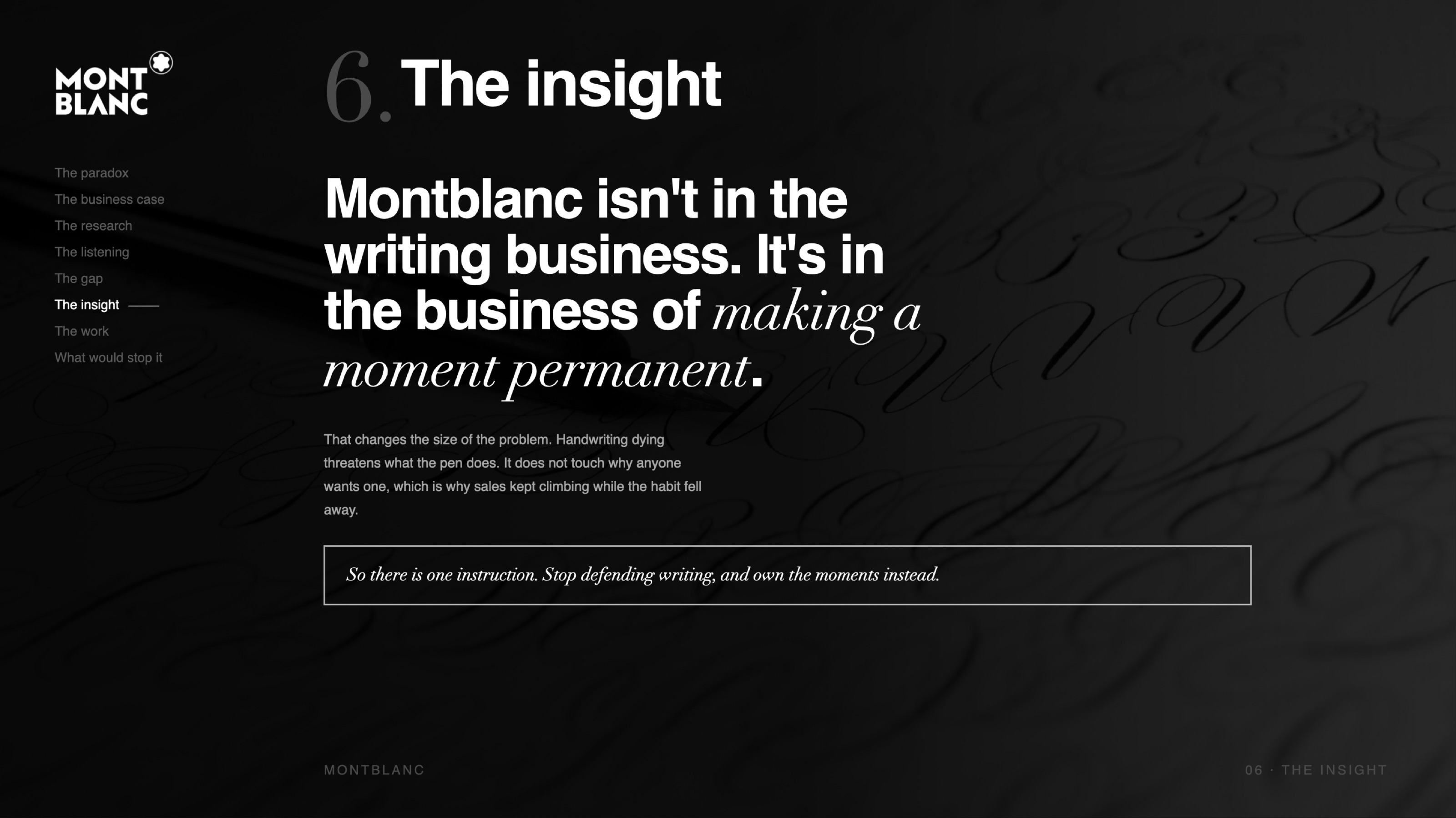
The insight Not the writing business. The business of making a moment permanent.
-
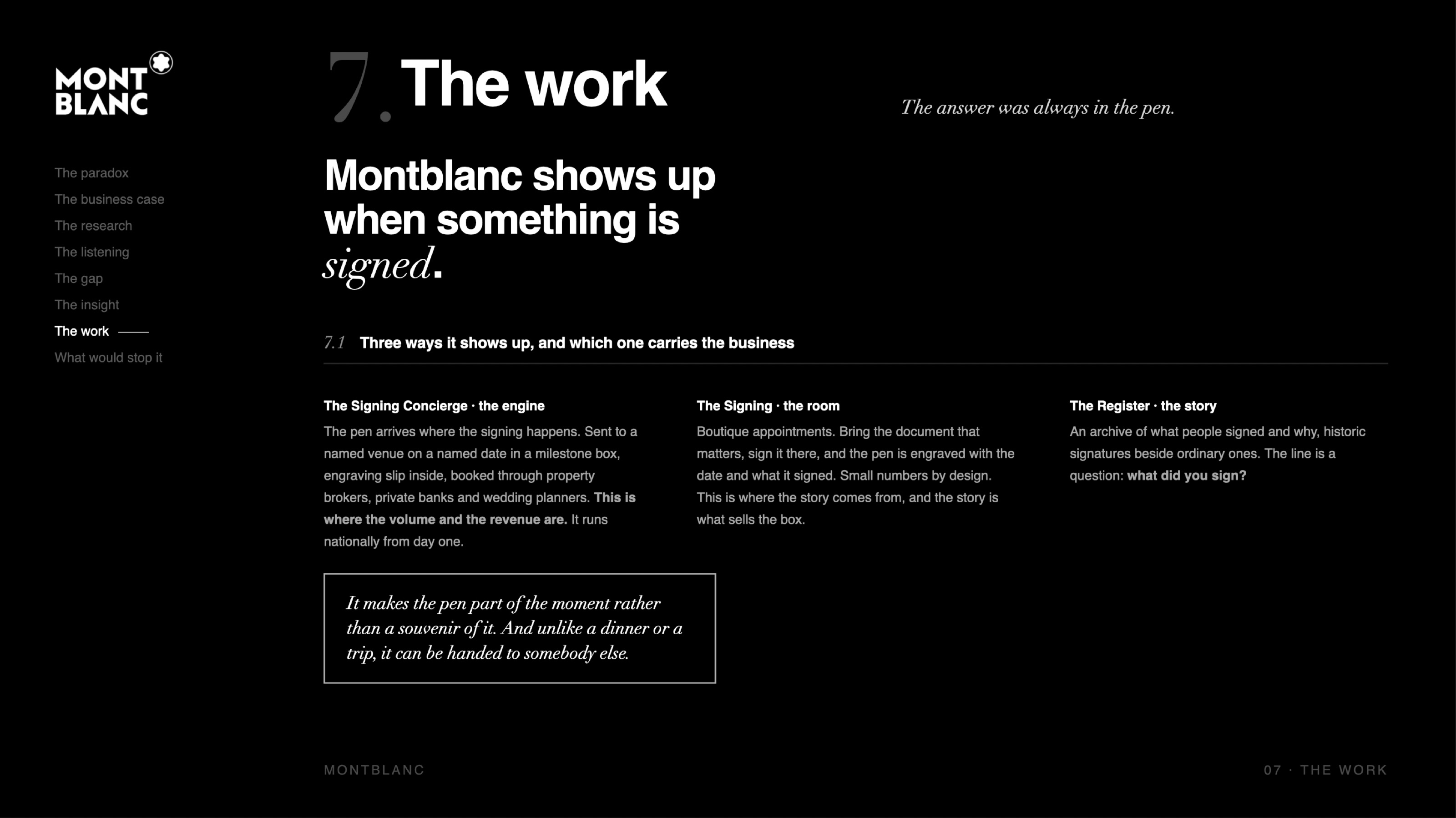
The work Montblanc shows up when something is signed.
-
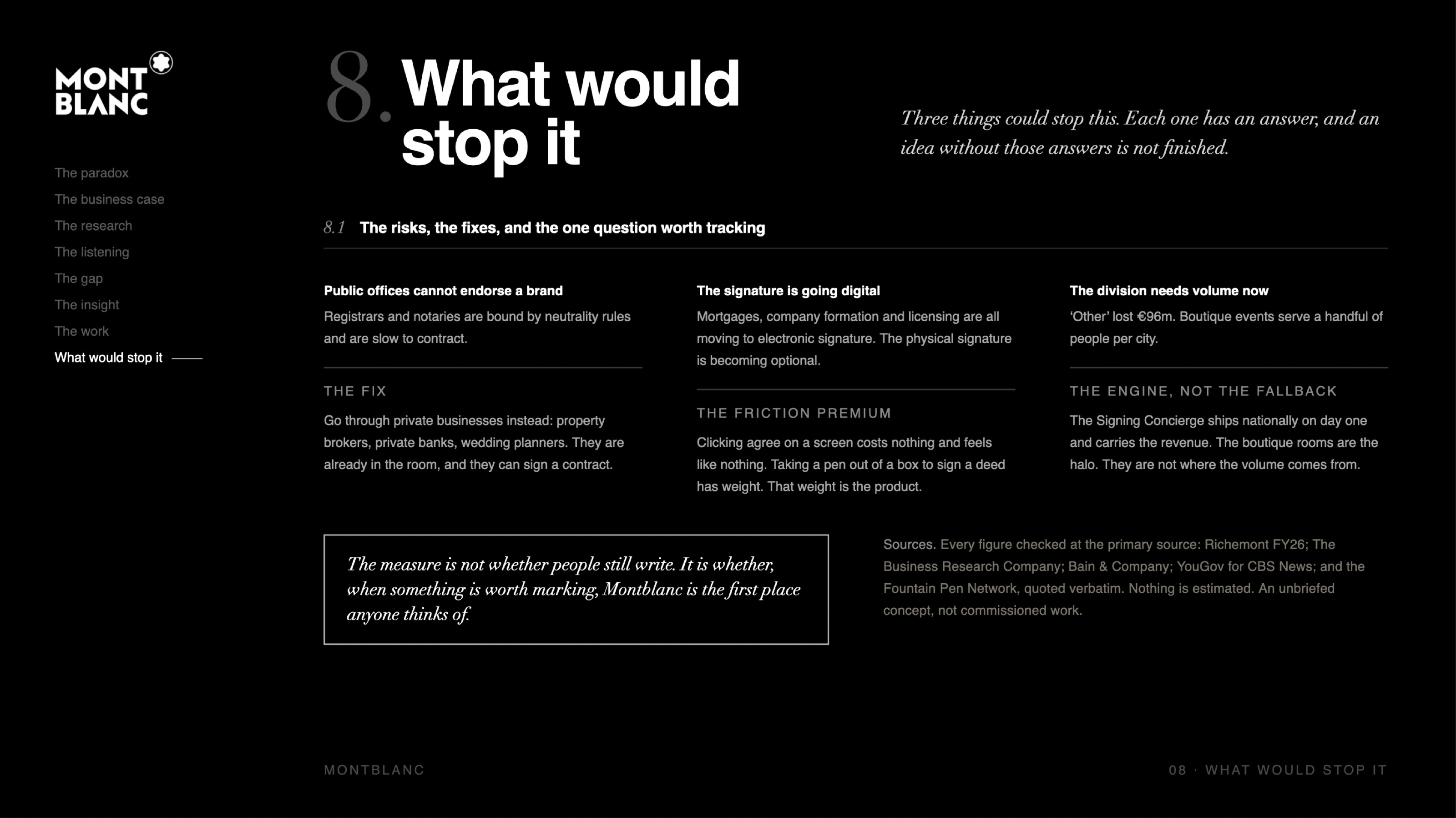
What would stop it Three risks, each with an answer, and the one question worth tracking.
Why it’s here
Every other case on this site is client work with a commercial brief attached. This one had no brief, no client and nobody to check it, which is the closest thing to how strategy actually starts.
It is also where I think this job is going. AI is changing how strategy actually gets done, and if you want to grow in it you have to grow with it rather than wait and see what it does to you. Building the thing myself was how I chose to keep up.